
GPU sharing and model slots
For the relationship between physical memory, free/unreserved budgets and model slots, see the memory and GPU-sharing diagram.
System → Hardware → GPU nodes → GPUs → GPU Configuration AMD / NVIDIA → GPU sharing provides the same administration for AMD and NVIDIA: Exclusive or Shared, a model-slot limit, transition status and explicit restart confirmation. The backend stays visible:
| Provider | Exclusive | Shared |
|---|---|---|
| AMD | AMD device plugin | Experimental AMD DRA, one shared claim |
| NVIDIA, Device plugin (default) | One allocation per physical GPU | Device-plugin time-slicing |
| NVIDIA, DRA (opt-in) | One model per selected physical GPU; a model can select several GPUs | One shared claim and bounded slots per selected card, including multi-GPU groups |
The settings are independent, including on mixed NVIDIA/Strix Halo hosts. New installations use Exclusive · one model per GPU for both providers. Merely opening Hardware does not change either provider. Apply is enabled only when the selected backend, mode or shared-model count differs from the current settings, including configurations that were not saved through this dashboard. Reverting an edit disables Apply again. The backend labels are DRA sharing configuration and Time-slicing configuration; no extra sharing checkbox is required. The final confirmation still explains model restarts and the lack of isolated GPU memory. Physical GPU accordions contain their memory layout first, device facts, then collapsed sharing controls. AMD runtime profile and shared-memory controls stay with the matching AMD GPU. A provider's single-device sharing form is never duplicated as independent controls on multiple same-vendor GPUs. Both sections start collapsed and can be opened independently. The NVIDIA sharing form appears once, in the first NVIDIA GPU accordion. Its GPU allocation backend selects Device plugin or DRA; it is a provider setting, not a separate configuration for each card. MIG and MPS are not enabled.
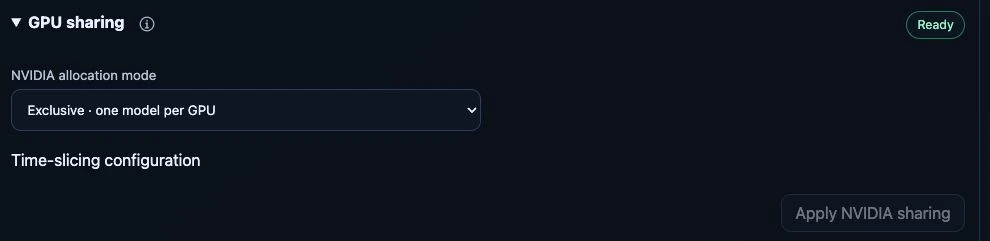
Unchanged NVIDIA configuration on the test appliance, 24 September 2026. Exclusive mode offers one model slot; opening this section did not apply a change.

Existing AMD shared configuration on the same test appliance, 24 September 2026. Four slots are this device's saved setting, not the installation default or a guarantee that four arbitrary models fit. No sharing transition was requested.
Model-slot accounting
Choose a GPU deployment
For ordinary vLLM and Ollama on NVIDIA DRA, Models → Create / Edit → GPU deployment separates three uses of the selected cards:
| Mode | What runs | Use it when |
|---|---|---|
| Single GPU | One model on one card | One card meets your needs. |
| Split one model | One model distributed across the selected cards | The model needs more GPU memory, or you want to try model parallelism. |
| Replicate model copies | A complete independent copy on each selected card | The model fits on one card and you want to serve more concurrent requests. |
Replication does not make a large model fit on smaller cards and does not guarantee faster individual responses or linear throughput gains. Both multi-card modes require NVIDIA GPUs on the same node. They are separate from Shared allocation, which lets different deployments share each physical card.
One model across several NVIDIA GPUs
Enable NVIDIA DRA first. In Models → Create → NVIDIA GPUs, check the cards to use. All cards appear in one list, including the first selected card. The selected count comes from the checked cards; there is no separate count field. Create and Edit save their exact identities. Uncheck a card to remove it from the group; a missing saved card stays visible until explicitly unchecked. Choose Split one model to distribute model weights rather than create copies.
- Ordinary vLLM and Ollama support same-node groups with different GPU models and physical capacities (up to the catalog limit of 16). Two- and four-card configurations have dedicated regression cases. This is not multi-node inference, mixed-vendor pooling, MIG, or a Omni setting.
- Card eligibility comes from NVIDIA DRA hardware inventory: current identity, the same node and a known positive physical capacity. Live memory totals or missing live samples do not determine which cards can be grouped. A disabled card explains a different node, missing verified capacity or exhausted slots. The engine and model/quantization must still support every selected GPU.
- A group consumes one slot on each selected card. For example, a model on two of four GPUs leaves the other two cards untouched. Admission waits for the whole group; it does not hold free partial groups while waiting for a busy card. Both Exclusive and Shared modes support groups.
- In Create and Edit, Total VRAM budget (MiB) covers all selected GPUs. The budget is divided equally across the cards. 100% unreserved is the smallest selected card's unreserved budget (bounded by its physical capacity), rounded down to 100 MiB, multiplied by the selected GPU count. For example, two otherwise unreserved 48 GiB cards provide about 96 GiB on this scale; a reservation on either card lowers the maximum for the whole group. The total changes in steps of 100 MiB per GPU. For different-sized cards, spare memory on a larger card does not increase this evenly divided budget. For example, 20 GiB and 12 GiB unreserved on two cards provide about 24 GiB on the total scale, rather than 32 GiB. Minimum, Recommended and Breakdown all show group totals for GPU components. Formula explanations show the per-card calculation and its multiplication by the selected count. Host RAM and download size stay separate; one split Pod's host runtime reserve and download are not multiplied. Estimates follow local cache/rank or layer placement and size runtime reserve from local shards. Uneven-weight placement receives a separate 10% allowance; full-model cache/runtime is not blindly repeated on every card. These remain estimates, not proof a model fits. Shared DRA does not isolate GPU memory. Ollama's layer placement remains runtime-managed, not a byte-exact VRAM cap.
- Advanced → Multi-GPU runtime offers vLLM Auto, Tensor, or Pipeline. Auto chooses Tensor when model dimensions divide evenly, otherwise supported Pipeline. It does not benchmark topology. Pipeline may perform better without a fast interconnect; model and quantization support are validated again at runtime. Unsupported models fail visibly rather than falling back to one GPU. vLLM converts the per-card MiB budget separately for differently sized GPUs; model loading still needs runtime memory headroom. Ollama manages its own layer placement and does not enforce a byte-exact per-card cap.
- System RAM is one Pod reservation/limit, not one per GPU. New forms propose the model-dependent startup recommendation; older APIs retain the former 16 GiB fallback. Serving, startup range and file cache are shown separately. vLLM includes its GPU workers; Ollama has one runner. Existing budgets stay unchanged unless explicitly edited. Independent copies retain per-copy RAM.
- Edit can change the group or strategy. The old Pod stops before the new placement; Stop releases all group slots after termination. Start reuses the saved group and waits if it is unavailable. A removed card or replaced node requires a new explicit selection. Logs and the routed API remain the same.
The runtime mappings are verified against
vLLM 0.31.0 parallelism
(--tensor-parallel-size, --pipeline-parallel-size, local mp executor) and
Ollama 0.40.3 settings
(OLLAMA_SCHED_SPREAD=true). vLLM checks CUDA-visible UUIDs against the complete
DRA group before loading. Its model probe does not enable trust_remote_code.
Hardware performance and successful multi-GPU inference require a live run;
local contract/browser tests alone are not hardware acceptance.
Independent copies on several NVIDIA GPUs
Choose Replicate model copies, then select at least two matching cards. The number of selected cards is the number of copies; no second replica count needs configuring. Each copy receives one exact GPU and serves independent requests under the same public model name through LiteLLM. Applications do not need to choose a copy or change their API configuration.
- The VRAM estimate and budget apply to each complete copy. Weights and KV-cache estimates are not divided by the number of GPUs.
- Advanced → System RAM per copy (MiB) and CPU requests/limits apply to every copy. For example, four copies with 16 GiB each reserve 64 GiB host RAM. The API checks the combined RAM budget against the selected node, including when CPU offloading is enabled. A memory-risk acknowledgement cannot bypass physical GPU capacity or this verified RAM ceiling.
- Each copy consumes one slot on its selected GPU. Unselected cards are not charged. A starting or failed copy keeps its reservation for retries; a terminating Pod keeps its slot until it disappears.
- Installed Models shows the ready/desired count and expandable Model copies with individual status. Logs → Model copy selects one copy; the default view shows the bounded set of newest Pods, not unlimited output.
- Healthy copies remain eligible for routing when another fails. The parent is Ready only when all copies are ready; it can be Starting or Degraded while healthy copies still serve requests. Status and routing updates reconcile asynchronously; in-flight requests are not transparently migrated.
- Edit drains the previous copies before recreating them with changed settings or placement. This is not a zero-downtime rolling update. Stop and Remove apply to all copies, while Start reuses the saved card identities. Cached model downloads remain available.
This implementation uses existing KubeAI runtimes and LiteLLM routing, not a new inference engine. It does not combine splitting and replication, autoscale copies, span nodes, or enable this mode for AMD or Realtime. Two/four-card, both-engine regression workflows are defined for Exclusive and Shared allocation; physical inference acceptance still requires running them on suitable hardware.
Accounting rules
Models shows a segmented outer GPU ring with free/total slots; memory rings
remain separate. Full GPUs are greyed out in the model form with a clear hint.
GET /api/models includes slots on GPU memory devices and compute targets,
plus engine-specific counts under engineAvailability. Device-plugin capacity
comes from Kubernetes allocatable resources. AMD DRA uses the ready,
node-identity-matched shared-claim limit; NVIDIA DRA uses a separate claim and
slot limit per verified physical GPU UUID. Desired but not yet ready DRA
configuration does not advertise usable cards or slots.
Enabled model activations reserve their replica slots before Pods exist. Matching KubeAI and direct Omni Pods replace those reservations, so they are not counted twice. Other GPU Pods, including validation workloads and terminating Pods, also count; completed Pods and deleted/disabled model intent do not. An enabled failed model retains its slot for retries. Removing a model releases its slot once its Pod has stopped. Slots are shared across engines, not inferred from RAM or VRAM.
Without confirmed physical placement, multiple GPUs on one node show one labelled Node slots pool above the physical memory gauges, not a repeated ring or an invented per-device assignment. Unscheduled intent is counted once per target and conservatively against eligible node/engine pools. With NVIDIA DRA, each card has its own ring. Starting a model reserves only its selected card; a queue bound to a full card does not consume sibling-card slots. Stopping releases its slot after its live or terminating Pod has gone. Editing an active model can reuse its own slot, not a different model's slot. The API rechecks availability before model writes (existing models can reuse their own slots). This is a scheduling snapshot, not an atomic Kubernetes resource allocation; the scheduler and sharing-controller admission remain authoritative if concurrent clients race for the last slot.
Initial scope and limits
- One selected, identity-checked Ready node per provider. AMD sharing manages one physical GPU; NVIDIA manages one or more whole physical GPUs on its node. Multiple NVIDIA nodes, MIG and existing external/custom allocator configurations are not silently adopted or overwritten.
- Model namespace
ai, one Pod per single/split runtime or per replicated copy, and 2–16 shared model slots. NVIDIA's limit is per physical GPU, including one slot per card in Exclusive mode. Additional models wait, ordered by creation time and name; disabling/removing a model releases its admission slot. - AMD DRA requires Kubernetes 1.36 or newer, native mutating admission policies and CDI. Existing Strix Halo host/profile checks remain required.
- NVIDIA DRA also requires Kubernetes 1.36+, native mutating admission policies
and CDI. It supports ordinary vLLM/Ollama single-card, split-model and
replicated-copy deployments in
ai. vLLM-Omni Realtime currently retain their NVIDIA device-plugin contract; stop those models before opting into DRA, or keep Device plugin selected. - AMD DRA uses
ghcr.io/qualityminds/magicstick-amd-dra:v1.0.1-cdi-recovery.2, based on upstream v1.0.1 commit9eb4e2ea386e34581524b0110e24769654fcb8d2. The AMD operator manages it instead of the mutually exclusive device plugin. The patch gives full GPUs a hardware-derived identity and restores volatile CDI files using this boot's device paths. Stale claims are quarantined without preventing registration or kubelet cleanup; see the recovery contract below. Publish the image withbuild-amd-dra-image.ymlbefore deploying the reference.
This is cooperative sharing for trusted workloads. Models compete for compute, bandwidth and memory. A slot is not a memory partition, a guaranteed throughput share or a tenant-security boundary. Existing memory estimates, RAM requests and risk warnings remain in force. A successful small test is not a guarantee that two arbitrary large models fit together.
The vLLM-Omni Realtime profiles accept AMD DRA and NVIDIA device-plugin sharing, using one slot per model and user-configured GPU-memory budgets. Shared replicas cannot form a two-physical-GPU stage plan. This does not imply memory isolation. Omni planning estimates are advisory for experimentation; real free-slot and device-binding checks remain.
Common API and configuration
GET /api/hardware/gpu-sharing returns a providers array. Each entry includes
provider, backend, mode (exclusive/shared), managed, experimental,
availability, desired slot count, observed phase, node identity and admitted
models. AMD also reports its device PCI address and shared claim. NVIDIA reports
draAvailable and, when DRA is Ready, a devices array with verified card UUIDs,
PCI addresses, capacities, node identity and claim names.
Administrator-only POST /api/hardware/gpu-sharing uses the normal CSRF checks,
provider (amd/nvidia), mode, maxModels, nodeName, nodeUid, the current
expectedRevision, acknowledgeSharing for shared mode and
acknowledgeRestart. NVIDIA additionally accepts allocationBackend
(device-plugin or dra; omitted preserves the current backend, with Device
plugin as the installation default). The dashboard supplies these acknowledgements only after
the final confirmation, without a separate checkbox. The underlying AMD
integration retains its bounded opt-in and hardware checks; its experimental
API flag is not a label for Kubernetes DRA itself.
The API stores bounded JSON in the selected ModuleActivation's
spec.parameters.gpuSharing, not Appliance.spec:
amd-gpu: internal modeexclusiveordra-shared.gpu: omittedallocationBackend(Device plugin) with internal modeexclusiveortime-slicing;allocationBackend=drawithexclusiveordra-shared.
Generic module/profile edits preserve this separate setting; the dedicated API
is the only dashboard write path. Automatic regression cleanup may also send
restoreDefaults through that same administrator-only endpoint to restore a
previously unset configuration. Its bounded fields describe an absent/present
parameter map and absent/empty sharing fields, not arbitrary module values.
The normal exclusive Device-plugin transition must already be Ready, with the
current node identity and physical extended resources confirmed. Clearing intent
cannot bypass draining DRA claims or stop an allocator by itself. Cleanup retains
the original saved configuration if this prerequisite or revision check fails.
ModelActivation.status.gpuSharing records
allocation mode and node, plus claim/device for DRA. NVIDIA additionally records
backend, node UID and GPU UUID. spec.local.gpuDevice persists the selected
nodeName, nodeUid and uuid; a replacement node or missing card requires a
fresh choice, not a silent fallback. Model readiness remains
separate from configuration readiness.
AMD backend
The operator stops only managed AMD KubeAI and Omni models before changing allocation
backends. It retains their activations and downloaded model data; CPU and NVIDIA
models are untouched. Unmanaged legacy AMD workloads block a backend change.
After the DRA driver publishes matching ResourceSlices, the operator creates
one namespaced ResourceClaim for the real device. Admitted models share it.
KubeAI's generated AMD resource profiles retain the existing CPU/RAM settings
and selected node. A native, fail-closed admission policy attaches the claim only
to marked AMD model Pods created by the KubeAI controller. An unadvertised
sentinel resource prevents CPU fallback if that adapter is absent. Neither CPU
nor NVIDIA profiles are rewritten by the AMD adapter.
The direct Omni Deployment attaches the same shared claim itself, with no
sentinel or admission shim and no extra amd.com/gpu request. Its admitted slot,
namespace, node UID and claim readiness are checked before creation.
The JSON patch uses plain JSON maps for claim-array values, with the composed
claim variable explicitly cast to string for CEL's homogeneous map typing. Typed CEL objects
inside those arrays can trigger a conversion panic in the Kubernetes 1.36 API
server before a Pod is stored. Validate the adapter with a server-side dry run
as the KubeAI ServiceAccount; checking policy creation alone is insufficient.
Optional Ollama/vLLM validation uses the same shared claim in ai, without
privileged workloads or GPU host-path mounts. Validation is manually requested
and does not gate normal GPU use.
NVIDIA backend
NVIDIA keeps its existing GPU Operator, ClusterPolicy, driver, toolkit and DCGM. Device plugin remains the default; installing this change alone does not switch an existing allocator or stop its models.
Device plugin and time-slicing
The shipped time-slicing-config ConfigMap contains immutable named profiles:
magicstick-exclusive and magicstick-shared-2 through magicstick-shared-16.
The Helm default is magicstick-exclusive. The legacy two-slot any profile
remains available unchanged for existing installations. The operator switches only the
selected node's nvidia.com/device-plugin.config label; NVIDIA's config manager
reloads the named configuration. No external ConfigMap is overwritten.
Before a change, only managed NVIDIA KubeAI and Omni models are stopped. Their
activations/downloads remain, and AMD/CPU models are untouched. Unmanaged NVIDIA
GPU workloads block the change. The controller waits for a ready device-plugin
Pod, the selected configuration label, matching nvidia.com/gpu.replicas and
matching allocatable slots across the node's physical cards. Model profiles then request one nvidia.com/gpu
allocation on the selected node, retaining their runtime, CPU settings and
CPU-offloading RAM requests/limits. No DRA claim is added to NVIDIA Pods.
The device plugin selects the card: Hardware offers an aggregate NVIDIA target,
not a misleading UUID dropdown.
An existing MIG configuration, externally selected plugin profile or a
ClusterPolicy pointing to a different ConfigMap blocks management without
rewriting those settings. A changed node UID requires a fresh selection.
The general mig.strategy=single/mixed setting alone does not imply active
partitions: non-MIG cards with mig.capable=false remain eligible. MIG-capable
cards using those strategies need corroborated all-disabled/success state;
MIG resources, partition labels or a pending MIG configuration block management.
Opting into exact-card DRA allocation
The standalone upstream dra-driver-nvidia-gpu chart and runtime are pinned to
0.5.0 / v0.5.0. The optional HelmRelease is installed with GPU resources
disabled and no node opted in. This is not an in-place migration to GPUCluster;
ClusterPolicy remains the operator contract.
Select DRA · select individual cards and the desired per-card slot count in Hardware, then review and confirm the restart. The controller:
- Rejects unmanaged NVIDIA workloads, foreign allocated claims, active Realtime models and unsupported/custom allocator configuration.
- Stops only managed NVIDIA model runtimes and waits for their Pods to disappear. Saved settings, downloads, AMD models and CPU models remain intact.
- Disables the selected node's device plugin and waits for its Pods and legacy allocatable resources to disappear before enabling DRA.
- Selects the actual driver root (
/for a preinstalled host driver,/run/nvidia/driverfor an operator-managed driver), then waits for the pinned driver and a complete current ResourceSlice generation. - Creates one UUID-selected claim per whole physical GPU, attaches claims to admitted KubeAI model Pods through the native fail-closed adapter, and only then publishes Ready cards and slots.
Models → Create / Edit now offers distinct cards by model, PCI address, node and
free slots. Each saved choice includes the installation's node UID. Full cards
are disabled; lost selections remain blocked until reviewed. The adapter uses
CDI and explicit ResourceClaims, not CUDA_VISIBLE_DEVICES to pretend a randomly
allocated device is the selected card. Shared Pods reuse their card's claim and
the driver's default time slicing; no alpha consumable shares, custom interval,
MPS or memory partition is configured. Missing DCGM readings remain unknown.
Optional Ollama/vLLM diagnostics also use that exact card's claim and wait for a free slot without stopping models. An all-card request creates distinct Jobs and keeps results scoped to the card identity; it does not reuse one result for all identical cards.
To return to Device plugin, confirm that backend in Hardware. The controller
drains managed consumers, waits for reservedFor and Pod references to clear,
deletes only owned unused claims with UID/resourceVersion preconditions, waits
for DRA Pods to stop, and then restores the device plugin. It never tears down
a driver still needed by kubelet to unprepare claims. Models with a saved exact
card selection stay blocked: in Edit, explicitly select Automatic NVIDIA
assignment (device plugin) to clear that selection before resuming them.
Revert the backend before removing the NVIDIA module.
This integration has isolated controller/API and four-card Chromium fixture coverage. A real multi-card acceptance run must still verify admission as the KubeAI ServiceAccount, Pod-to-UUID binding, inference, restart recovery and both handoff directions. Fixture results are not hardware certification.
Upgrading older NVIDIA defaults
Before reconciling the new Helm default on an older installation, inspect the
current ClusterPolicy, node profile label and advertised replica count. If the
node still inherits the former any profile and that existing allocation should
remain, pin nvidia.com/device-plugin.config=any on that node before the upgrade.
Retain existing explicit or custom node profiles; do not overwrite them or infer
a profile from an unknown configuration. New nodes without an explicit profile
use the exclusive default. Changing an existing allocation remains a separate,
confirmed Hardware action.
Recovery and diagnostics
Restart recovery and legacy migration
Full AMD GPU names derive from PCI address, vendor/device ID, partition profile
and sysfs unique_id when a nonzero value is available. The upstream KFD
location-derived ID is not treated as a hardware UUID. DRM cardN and
renderDN numbering is resolved from current discovery, never from the DRA name.
Without a hardware unique ID, the fallback identifies a PCI location and model,
not an indistinguishable replacement at the same slot. PCI/topology or identity
changes are not silently migrated. Partitioned AMD devices are outside this
Magic Stick sharing profile; legacy partition checkpoints fail closed.
Checkpointed claims now contain their physical identity. On restart the driver
regenerates CDI device nodes and permissions only for matching hardware. Invalid
claims lose their stale CDI files but retain their checkpoint entries until
kubelet calls Unprepare. The driver stays registered to process that cleanup.
Known affected GPUs are withheld from ResourceSlices; an old checkpoint without
physical identity conservatively withholds the whole AMD pool. Unprepare is
idempotent, including after loss of /run/cdi, and republishes inventory after
the last blocking claim has been released. No boot script clears checkpoints,
and the plugin never infers that a shared claim has no remaining consumers.
ResourceSlices publish the identity's SHA-256 digest to respect Kubernetes'
64-character attribute limit; the controller verifies it against the reported
hardware fields before creating a shared claim.
The controller hashes hardware identity, node UID and namespace for new shared
claim names. It retires older Magic Stick-owned claims only when their saved
selection matches, reservedFor is empty and no Pod references them. Deletion
uses UID and resourceVersion preconditions; a new claim waits until deletion is
observed. Active, terminating, foreign or differently selected claims are not
force-removed.
Existing models using legacy claims must first stop normally. A lost kubelet
checkpoint or uncertain consumer state requires operator review, not blind
automatic cleanup. API errors leave allocation blocked.
Publish the recovery.2 image before deploying the controller reference. The first migration may briefly withhold AMD inventory while kubelet releases legacy claims. Do not roll back to recovery.1 with new-format active checkpoints: drain consumers and let kubelet unprepare all claims before downgrading. This AMD recovery procedure does not modify NVIDIA's driver or allocations.
Optional validation lifecycle
ai-system/magicstick-gpu-validation-history is a runtime-owned ConfigMap.
Before creating a diagnostic Job, the controller durably consumes its manual
request. Completed results and runtime image identity are saved before adding
a 300-second Job TTL. Deleted/interrupted Jobs are reported as failed rather
than recreated. A new explicit request is required to retry; host or image
changes make prior results stale. Both legacy AMD and per-device AMD/NVIDIA
diagnostics use this history. The legacy queue does not delete device-scoped
Jobs. Inference eligibility remains independent of optional diagnostics.
History updates use resourceVersion concurrency checks. If history is unavailable or exceeds its 750,000-character safety bound, new diagnostics stop without discarding consumed requests, deleting unarchived Jobs or disabling GPU driver reconciliation. Export history before maintenance; do not clear it while saved validation requests remain active, as that would remove their retry protection.
Acceptance checks
The image build runs Linux Go tests for renumbered DRM nodes, missing/replaced
GPUs, legacy/malformed checkpoints, repeated Prepare/Unprepare and isolation of
known affected devices. Controller tests cover claim ownership, multiple/ending
consumers, API failures, UID-guarded migration and persistent diagnostic history.
An opt-in MAGICSTICK_TEST_LIVE_DISCOVERY=1 Go test reads real AMD inventory while
keeping all checkpoint/CDI writes in temporary directories. It does not replace
the release gate: cold/warm boot on a mixed AMD/NVIDIA host, restored ResourceSlices,
normal shared-claim cleanup and successful model inference on both providers.
Changing allocation mode
Select Exclusive · one model per GPU and confirm the restart. For AMD, the controller stops managed AMD models, waits for claim consumers to release the GPU, removes its shared claims and restores the device plugin before resuming models. The reverse operation remains available if the selected hardware no longer qualifies. Do not remove the DRA driver while its Pods are still terminating: Kubelet needs the driver to unprepare their claims. If host evidence temporarily becomes stale, new DRA model admission is blocked but the driver stays on its selected node so existing claims can still be released. An eligibility-label change must not tear down that driver first.
Inspect compatibility.sharing in the appliance's AMD operator status for
Switching, Starting, Ready or Blocked. Inspect the actual claim allocation
and Pod events if models remain pending. A Blocked sharing setup is reported
as Degraded / GpuSharingBlocked on the model, not as runtime startup. Inspect
Pod events and controller logs; an amd.com/gpu extended resource is
not expected while DRA owns allocation. The dashboard counts the physical DRA
device once, not once per model slot.
For NVIDIA Device plugin, the same action selects magicstick-exclusive, waits
for one allocatable slot per physical card and admits that many models. DRA
Exclusive keeps one explicit claim/slot per card; it does not switch backend.
Inspect
Appliance.status.hardwareOperators.gpu.sharing, the selected node label and
device-plugin/config-manager or DRA driver logs for progress. Neither path treats
replicated slots as additional physical GPUs.
Upstream references
- AMD operator DRA integration
- AMD driver: multiple Pods sharing one claim
- Kubernetes mutating admission policies
- NVIDIA time-slicing and per-node configuration
- NVIDIA DRA chart installation
- NVIDIA DRA ResourceSlice attributes
- NVIDIA DRA GPU selection
- GPU Operator 26.7 DRA and GPUCluster migration limits